
Origins of Pediatric Surgery

As part of the WOFAPS History of Pediatric Surgery series, we are proud to share a collection of articles, lectures, presentations, videos, and historical archives that celebrate the pioneers, milestones, and evolution of our specialty.
Through preserving and sharing the history of pediatric surgery, we honor those whose vision and dedication laid the foundations for modern pediatric surgical care while inspiring future generations of surgeons around the world.
Join us as we explore the remarkable journey of pediatric surgery through stories, historical lectures, rare presentations, and educational resources from across the global pediatric surgical community.
The following is a lecture by Pepe Boix Ochoa titled “Origins of Pediatric Surgery“
I must admit that when Prf. Amadeo Zanotti proposed that I give the opening lecture of the Cipesur Congress, I felt immense joy at the honor it represented.
When he told me the proposed title, I thought that although it wasn’t my field and I had never spoken about it in my 35 years as Secretary General of WOFAPS, it wouldn’t be difficult to put together the lecture.
Big mistake. Never has a lecture been so challenging for me, and I still don’t know if you’ll like it.
Why? It all starts when I encounter the phrase “Origins of Pediatric Surgery.”
When I immersed myself in this research, I realized it was a much more difficult topic than I had imagined, and it has taken me months and trips to libraries all over Europe. If it weren’t for the help of some very dear friends, I wouldn’t have been able to discuss some of it.
Why?
Simply put, until well after the Renaissance, the child as a child didn’t exist; they were simply seen as a miniature adult, and very little or nothing was said about them.
However, if we think about it, between 3500 BC and 100 AD, life expectancy was between 30 and 40 years, so according to our current standards, 40% of all surgeries were pediatric. Consider that at the age of 7, children in Sparta were already entering military service. What was the scope of Pediatric Surgery? What did we understand by Pediatric Surgery in those times?
On the other hand, Pediatric Surgery as such could not exist until its older sibling, “Pediatrics,” emerged, and it wasn’t recognized until the 19th century, with the arrival of the Industrial Revolution and the entry of mothers into the workforce. This led to the development of the first step: “Puericulture” for wet nurses. Logically, there had been earlier attempts in this field, such as Bagellardo’s book in 1440.

But let’s return to our origins; surgery on children, even if they were treated as small adults, has always existed. We can go back to 2000 and 3000 BC to learn about the earliest attempts through Mesopotamian cuneiform tablets, Turkish writings, Egyptian papyri, and Greek, Roman, and Mesoamerican literature.
The earliest attempts were always on the body’s surface: the removal of foreign bodies, thorns, and stones, either by suction or by extraction with all sorts of instruments, ranging from flint tools to more modern copper and silver ones, depending on the era.
Special attention should be paid to the Mesoamerican custom of shamans using cranes, whose sharp beaks, shaped like forceps, and trained by feeding them on the wound, could extract foreign bodies from deep within.
Time will be short, so we will focus on four civilizations that represent a compendium of all humanity: India, Egypt, Turkey, Greco-Roman, and the Middle Ages, and then we will discuss some pathologies.
In all the civilizations studied, surgery and medicine were intertwined with religion and astronomy and reserved for shamans with special powers, knowledgeable in a wide variety of herbs that reduced pain, provided relaxation, or produced a temporary pseudo-anesthesia. In almost all cultures, a deformed newborn is abandoned or killed according to the laws of the country, as in Sparta, where the court decided whether the infant should be thrown from Mount Tarsus, or in other civilizations with specialists in infanticide.
But let’s briefly list the main ones:
INDIA; Undoubtedly one of the oldest civilizations and, along with the Egyptian, the most developed in the external surgical treatment of the human body, although there is evidence of internal interventions. Its influence on the development of Surgery and Pediatrics is extraordinary for future times.
The Vedas and the compilation of medical science by Susruhta in his work Susruhta Samihta are fundamental to later Pediatric Surgery.
The description of the instruments and their applications, the control of hemorrhage and its sutures, as well as the basic principles for anesthesia and surgical asepsis are extraordinary. All types of minor pediatric surgery were performed without major complications.
Plastic Surgery; Punishment Reconstruction
And we’re talking about more than 3,500 years ago!!!

And since we’re talking about reconstruction, let’s dedicate a few minutes to cleft lip and palate.
The first reported intervention is from the 4th century in China, although some mummies in Egypt already presented this condition. In the Corinth Museum, there is a terracotta figure with this malformation, and the intervention for centuries consisted of incising the lips and suturing them for weeks.
Ambroise Paré described it and gave it its current name, “rabbit mouth.”
Many types of operations were attempted, but it wasn’t until the 20th century, with Malek’s triangular flaps or Millard’s rotary flaps, that exquisite results were achieved.
Now we have EGYPT; I’m sure that all cultures and civilizations, 4,000 or 5,000 years ago, reached similar levels of knowledge in medicine and surgery, differing from one another in small details and beliefs.
But without a doubt, one of the most studied, researched, and known through its papyri is Egyptian medicine.
A library of knowledge and innovations, recognized because it was mostly religious figures who practiced it under strict controls.
The papyri were found in 1860 and finally translated in 1920 due to the difficulty of their interpretation, but they open a window onto the immensity of their knowledge, described in the Edwin Smith Papyrus, from which it can be deduced that specialties with their diagnoses and treatments already existed. Their great advances were based on their profound knowledge of anatomy, which they used in mummification, believing in an afterlife. The process lasted 70 days.

One of the most prominent and renowned physicians was Imhotep, a doctor of the 3rd Dynasty, who, due to his knowledge and healing abilities, was elevated to the title of “God of Medicine.” A small sample of their knowledge can be seen in the engravings and inscriptions of the Kom Ombo temple, revealing the various surgical instruments they employed. No flint, only iron, bronze, and sometimes silver.
Abscesses and skin tumors were opened by cutting with red-hot instruments, as this also cauterized the wound.
For suturing wounds, they used linen or tendons from small animals, unlike in Mesoamerica where they used the heads of army ants as staples—brilliant! Trepanation, as we will discuss later, was attempted to treat hydrocephalus and epilepsy, and to expel evil spirits.
For urethral strictures, roots that dilated with moisture were used for the first time in ancient cultures.
And, of course, they also successfully performed tracheotomy.
King Ptolemy, in the 4th century BC, built the Great Library of Alexandria with more than 900,000 manuscripts, making it the World Center of Knowledge. Both the Greeks, with Hippocrates, and the Romans, with Galen, visited it, bringing its medical teachings back to their countries.
And now we will touch on a simple topic with all kinds of variations according to cultures, customs, and rituals: phimosis.
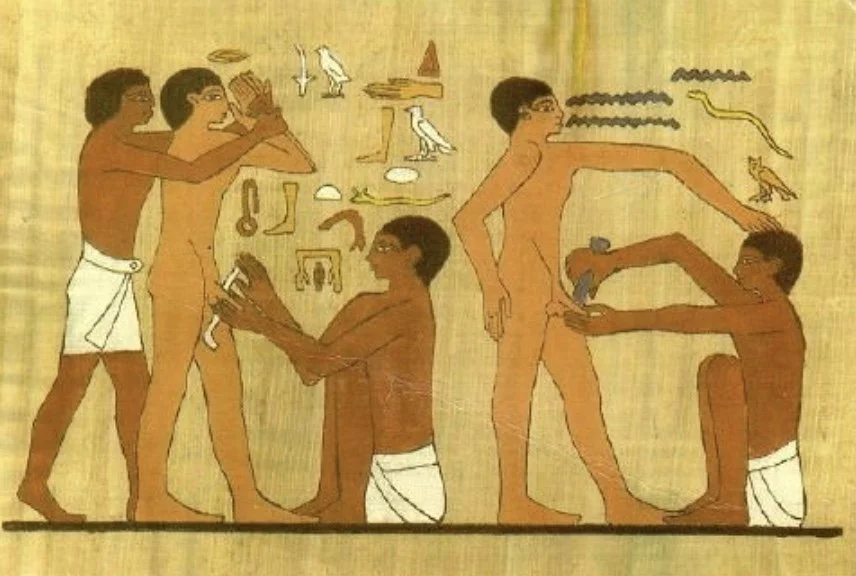
Circumcision appears in all the cultures studied between 4,000 and 5,000 years before the present era.
Its causes can be diverse. In Egypt, mutilating or castrating slaves diminished their value, rendering them unfit for work. Thus, this form of punishment was adopted, which the Jews, upon leaving Egypt, later transformed into a religion, appearing in the Torah as recounted in the words of Jehovah to Abraham. When Christianity emerged, circumcision continued, but to avoid resembling Hebrew religion, the practice was discontinued in 50 AD at the Council of James the Just. As a historical detail fraught with questions, there is the case of Michelangelo’s David. He was Israeli and defeated Goliath, so why isn’t he circumcised? What are the reasons?
In any case, in other cultures it’s a rite of passage from childhood to adulthood, with all sorts of ointments used to minimize pain—Turkey, Africa, etc.
Fractures and dislocations are treated the same way in all cultures: muscle relaxation with medicinal herbs and bandaging after reduction with wooden strips to stabilize the repositioning, and later, the use of plaster casts thanks to Ambroise Paré.
It’s even claimed that the Quechua people of Peru knew of herbal extracts that, when applied to the skin, softened the bone, facilitating its reduction.
I personally have seen before and after X-rays. The composition of these herbs is completely unknown, and they are found in areas where modern civilization has not yet arrived.
And let’s move on to another universal issue that was difficult to resolve until the advent of anesthesia: the inguinal hernia.

In the Babylonian Codex Medicus of Hammurabi, an attempt was made, with disastrous results, to reposition and then completely suture the inguinal region. Logically, this meant the loss of the corresponding testicle and possible intestinal ligation with consequent intestinal obstruction.
In the Edwin Smith Papyrus, attempts were made to reduce the testicle and apply bandages, and even to completely cauterize the area. Studies of some mummies have revealed that they underwent surgery.
Hippocrates and Galen attempted the same method, but by opening the inguinal canal, reducing the testicle, and closing the inguinal orifice. They believed the spermatic cord to be a nerve, and their results were very poor, but the procedure continued in a similar way until the 14th century, when the descent of the testicle, but with ligation of the spermatic cord and closure of the inguinal orifice, was described in Stromayr’s Práctica Copiosa.

In the 19th century, Bassini provided the precise anatomical knowledge and the technique that is still followed today. Before moving on to other periods, it is necessary to conclude this first part with the universal figure of Avicenna, born in Cordoba in the 10th century, who, in his treatise on surgery, compiled in the 11th century all the knowledge described up to that time, improving it and inventing instruments still used today: tracheotomy, lithotomy, tonsillectomy, herniotomy, reduced and immobilized fractures with plaster casts, and ligation of blood vessels. He used alcohol for asepsis and absolute cleanliness of the operating room and his assistants.
Until the appearance of Ambroise Paré and beyond, his Canon of Medicine was the most respected until the 17th century.
All cultures advanced at the same pace, and surely Avicenna’s writings inspired Sabuncuoglu Seraffedin to publish the first atlas of Pediatric Surgery with innovations and improvements on Avicenna’s techniques.
A magnificent atlas that marks the dawn of Pediatric Surgery. In it, he meticulously treats and describes the techniques used; Hydrocephalus, frenulum sectioning, hypospadias treated with extremely fine scalpels similar to those used today, circumcision, inguinal hernia repair, hermaphroditism, labia minora repair, fracture treatments, and orthopedics. The treatise’s scope and meticulousness are inconceivable.
And we have witnessed the first description of the treatment for anorectal malformation, a subject with a long history of research, but one that demonstrates the unstoppable progress of our specialty.
We can distinguish three distinct stages: the lack of anatomical knowledge for continence; the beginning of anatomical knowledge; and the current state.
An attempt to describe the anal region was already made by Galen, but without surgical consequences.

The first intervention was performed by Paul of Aegina, an intervention followed by dilations. This technique, which lasted for centuries, was already described in Sabuncuoglu’s 16th-century atlas.
In the 17th century, Ruiysch described an anal membrane, and only in the 17th century did the first interventions begin, even with prior colostomy.
In the 19th century, John Campbell was the first to treat anal atresia with relative success in the USA, and 35 years later, Amurat performed the first successful anoplasty, followed by the pioneers Rhoades, Pipes, and Randall.
All of this led D. Stephens in Australia to conduct an exhaustive anatomical study of the region in search of continence, and his teachings gave rise to the Rehbein and Soave techniques.
Finally, in 1980, Alberto Peña, with his posterior sagittal approach and greater knowledge of anatomy, achieved the definitive update of the principles of its correction.
18th and 19th Centuries: The breeding ground for its emergence began to form; the child was no longer a small adult, and the first major book on pediatrics by Nils Rosen, the father of pediatrics, appeared. The child had triumphed, but surgery was accompanied by pain until anesthesia appeared in 1846.
Pediatrics and anesthesia: the miracle of our specialty began to take shape, but anesthesiologists had a terrible fear of anesthetizing children.
From the 16th to the 18th centuries, the continuous European wars led to the emergence of a number of surgeons specializing in general surgery, treating wounds, abscesses, and performing amputations. These so-called barber-surgeons could cut your hair or amputate a leg just as easily.
Children began to be recognized as such, but surgery was terribly dangerous for them.
The ancient concepts compiled by Avicenna and Sabuncuoglu were followed with slight alterations, such as the publication by Felix Wurzt.
Nothing would change until the emergence of its older sibling, “Pediatrics,” and the advent of anesthesia.
Children and pediatricians feared general surgeons, but books dedicated exclusively to Pediatric Surgery were already beginning to appear.
It was only a matter of time, and with the appearance of the first children’s hospitals, a giant leap was taken in the recognition of our specialty, which grew exponentially.
Interventions on newborns and young children were already achieving astonishing successes. Pediatric surgery is booming, and the first Pediatric Surgery Associations and Societies are emerging, leading to the creation of highly specialized journals.
In some countries, pediatric surgery still struggles with two specialties that challenge its hierarchy. There are the specialized general surgeons, who want to dominate a specific area of the body from birth to old age, and the pediatrician, who believes the child is their patient and we are mere craftsmen whose area is limited to the operating room and who considers diagnosis, pre- and post-operative care their right because the child is “theirs.” Nothing could be further from the truth.
We must work shoulder to shoulder for the child’s well-being, but in no way should we be subordinate to them. We are an independent specialty, and the general surgeon must understand that their knowledge is for adults, not children. The proof is that when they have young children, they take them to the pediatrician because children are different from adults, but their ego, thirst for power, and sometimes financial reasons prevent them from seeing reality. The child is different and belongs to Pediatric Surgery.
Once the Societies were established and the Specialty was recognized in most countries, the conditions were right to form an International Society, and thus WOFAPS began.
I will tell you about its history from its beginnings to the present day, as I have witnessed these last 55 years.
In 1963, at the French Congress in Paris, Professor Pellerin proposed the creation of the “International Union of Pediatric Surgeons,” in which all the Societies would unite while maintaining their complete independence to fight for our specialty and exchange experiences. There began the battle of egos, ambitions, and age-old rivalries.
At the BAPS Congress in 1964, the first contacts were made; almost all countries, even the American ones, accepted it, but BAPS saw its hegemony at that time threatened and opposed it outright, halting the idea.
Faced with this situation, Lozoya Solís, the political wizard, along with Carvalho Pinto and Pellerin, founded the World Symposia on Pediatric Surgery with unprecedented success.
Faced with the success in Paris, BAPS had to back down, and the details began to be discussed in Bogotá, Glasgow, and finally, in London, the definitive creation of WOFAPS was decided at the third World Symposium in São Paulo, where the first WOFAPS Council Meeting took place, electing the first WOFAPS board in 1974.
However, at the second WOFAPS Congress and fifth Symposium held in Barcelona, the two associations decided to separate; WOFAPS moved to New Delhi and the World Symposium to Acapulco.
Since then, 15 WOFAPS World Congresses have been held, and the next one will be in 2019 in Doha, Qatar, under the presidency of Professor D. Sigalet.
The growth has been exponential: from 16 societies in 1974, we have grown to more than 115, including international associations.
During Jay Grosfeld’s presidency, the global declaration of our specialty was decided in Kyoto, and the establishment of our own Congresses was formalized at the Tokyo Congress under Professor Miyano.
The first Congress was a success and took place in Croatia.
The specialty is so highly respected that, according to the IPA Constitution, one of our representatives will always be on the Executive Committee, and at the World Congress of Surgery, Pediatric Surgery has three sessions. Initiated by J. Grosfeld, it is now led by Professor P. Puri.
Our future lies with the new leadership and in their hands.